Thursday, April 24, 2014

Non fiction Blog Post

The article "21st Century Slavery" in the Upfront Magazine by Alessandra Potenza is about slavery. Not just slavery in general, but slavery in the 21st century. According to Potenza, slavery is not "a thing in the past", like how many people think it is.
According to the article, the countries with the most modern-day slaves are: Russia, China, Bangladesh, India, Uzbekistan and Brazil. In Uzbekistan, the slavery is forced by the government, in contrast with other countries, in which they are "owners" and people are "owned".
Many slavery jobs include fishing, like "Min Min", mining, cocoa farming for chocolate, and sex trafficking. As many as 27 million people are in modern day slavery, according to the U.S. Department of State.
From the author's point of view, slavery is a horrible thing. No one should work for 18 hours and not get paid a single penny, like Ima Matul (she was a former slave in the US). And in general, the author too wants to inform the reader that slavery is not good; and something should be done.

Monday, April 21, 2014

Romeo And Juliet by William Shakespeare Essay

     Romeo and Juliet, written by William Shakespeare in the late 16th century, is about two inseparable  lovebirds. Romeo is the son of the Montagues, whereas Juliet is the daughter of the Capulets. The  Montagues and the Capulets have been feuding with one another for several generations. If either of Romeoor Juliet’s parents found out about their love for one another or their secret marriage, then the consequences would be deadly. Those two themes of consequences and death are developed throughout the play, and each consequence leads from one event to the other, until the end, in which both lovebirds die.
     
      In Act 3, scene 1, Tybalt, who is a Capulet, seeks revenge from Romeo because Tybalt saw him at the Capulet's party, in which he was not invited since he is a Montague. His revenge is to duel with Romeo, but instead in Line 84, Tybalt starts sword fighting with Mercutio. In lines 101-102, Mercutio claimed “Ask for me tomorrow, and you shall find me a grave man”. To paraphrase, Mercutio knew that he would die, which connects to the theme of death. The result of Tybalt killing Mercutio was that Tybalt was to die, due to the Prince's orders of no fighting on the streets of Verona, which is another connection to death, as well as consequence. However, Romeo decides to sword fight with Tybalt, for killing his best friend Mercutio. Romeo succeeded in killing Tybalt, but due to his actions, he got banished from Verona (3.3).

      Romeo is banished from Verona, 3.3. 9 & 12, when Friar Lawrence states “I bring thee tidings of the Prince's doom .... No body’s death, but body’s banishment”. Romeo has to go to Mantua instead of being killed because he violated the Prince’s order of peacefulness on the streets of Verona. In other words, he made death happen when it unnecessary (Tybalt was going to die anyways). Going to Mantua was a big deal for Romeo because Juliet, the love of his life and secretly, his wife, would not be there. Romeo even says to Friar Lawrence when he tells him the consequences in 3.3. 13-15: "Ha, banishment? Be merciful, say "death," For exile hath more terror in his look, Much more than death. Do not say "banishment"".  This shows that Romeo would rather die then to be banished. On the other hand, Juliet then had to deal with the fact that her husband is not going to be there, and that she was going to marry Count Paris, who is a kinsman of the Prince, in a couple of days. In Act 4, Scene 1, Line 95-96, Friar Lawrence says to Juliet "Take thou this vial.... And this distillèd liquor drink thou off". He gives her a potion in which she will appear dead, when really, she will be in a deep sleep. The effect of Juliet taking the potion would be having the excuse of not marrying Paris, and intending to runaway with Romeo to Mantua.

       In Act 5, Scene 3, Romeo has returned back to Verona from Mantua to collect from Juliet "A precious ring, a ring that I [Romeo] must use". He sees that Juliet is dead, in 5.3.84 lying in a tomb next to her dead relatives.  He did not know that in fact Juliet was alive; that she was just in a deep sleep. He did not know this because he was in Mantua. Romeo loved Juliet so much, he killed himself for seeing “death” upon his very own eyes. In 5.3.119-120, Romeo’s last words were “Here’s to my love. O true apothecary, Thy drugs are quick. Thus with a kiss I die"Soon after this being said, Juliet awakened from her deep sleep. She was heartbroken when she saw that her husband, Romeo, had drank the poison and was dead. Very upset by this, she took the dagger from Romeo, saying "let me die" before she stabbed herself to death. 

      In conclusion, all these events lead to one another as consequences, with death playing a big role: from Tybalt killing Mercutio; Romeo killing Tybalt; Romeo being banished from Verona; Juliet fake killing herself; Romeo committing suicide; finally to Juliet really dying. Shakespeare developed the story of these two unfortunate lovebirds through these two themes.



Thursday, March 20, 2014

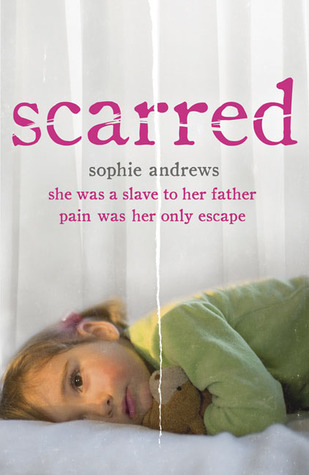
Scarred by Sophie Andrews

Scarred by Sophie Andrews


The book "Scarred" by Sophie Andrews is an autobiography of when Sophie was younger (in her teenage years). She ended up in a psychiatric unit at only age 16. While her life seemed normal, it wasn't. Her father, who did not look like a type of person who would do this, raped her every single night from the ages of 7 to 16. He would bring his friends along to do horrific things to her, and he loved the blood! It excited him/ This made Sophie feel like pain was her only escape by cutting and being depressed. This is how she ended up in a psychiatric unit at age 16. Although Sophie lived a life many do not have to go through, she definitely changed throughout the book.

An example of Sophie changing is when she has a chance to leave the hospital for a small period of time. It is near the time she needed to leave the unit, or "nuthouse" as Sophie likes to call it. In the past, she would not have come back, and try to find her father. But instead she came back to the hospital.

Another way she changed was she changed was she learned to love the hospital. When it was time for her to leave the unit, after one and a half years, she did not want to go. However, in the first 6 months of her stay, all she wanted to do was to leave.


Thursday, March 6, 2014

Revised Blog Post!

Click here to go to the original blog post

In My Hands: Memories of a Holocaust Rescuer  by Irene Gut Opdyke 


        The book "In My Hands: Memories of a Holocaust Rescuer" is about how Polish-born Irena, now known as Irene, was separated from her family due to World War II. She started working for the enemy, the Germans, and as a result ended up rescuing many Jews when it was unquestionably risky. She ended up saving all their lives; and even helped make a new life. The main reason she did this was because she thought by helping them she was doing the right thing. The main issue in this book is war, which causes several minor issues, and it is evident that war can bring injustice to many people.
        Pre-World War II, life, at first, was quite normal. Irena and the rest of her family, who happened to be a non-Jewish Christian family, lived life quite normal, just like most of the other families in Poland, where they were living, at that time. The whole family had food to eat (although not as much as they might have wanted). The whole family still lived under one household and were treated pretty well (of course they were not Jewish). This was a typical lifestyle back then. Normally, before a war starts, a family is in well terms. In other words, a family is more or less like how Irena's family was back then. This was all before September 1, 1939, the start of World War II.
        After the first of September, that's when things started to change. Now, Poland was no longer the country it used to be. It was in ruins. This can happen in any war: a country is known for the beauty and then BOOM! it is nothing more than tore down buildings and debris. For example, Irena describes the beginning of the war as follows: "Before I even saw the planes, I began to hear explosions.... Across the field from where I stood, the front of an apartment building suddenly sheared away...a blue plush sofa toppled to the street." The same thing goes to family; families can get separated, or die, or injured, etc. For example, "a toddler whose face was streaked with dirt and tears.... I saw a woman whose hands were covered with blood". These examples prove that civilians can easily get affected by war and that life might be fine one day but the next day it is a total disaster.
       Even after war is over, several people are still faced with injustice. For example, in the book, Irena made the choice of joining the resistance after escaping the Soviets and Germans. Unfortunately, she was caught, but she escaped the holding place in where the Soviets were holding her. And long after the war ended, about a year and a half, the Soviets caught her. And because of this, she was forced to start a new life in a new country with a new language (The United States). In war, this type of thing happens all the time: people are still victims years and years after a war officially ends. For example, take the Holocaust. Many people were still victims of the Holocaust years after the last camp got liberated. The reason for this was because many people were still left homeless and helpless, not knowing what happened with their family, and to make matters worse, the prejudice still happened. It still happens today.
        In conclusion, war has its consequences. And the consequences (most of the time) are perfect examples of injustice. The book "In My Hands" perfectly shows that statement. In the beginning, Irena and everyone is carefree. In the end, everyone who lived through that experience is scarred forever.


Monday, February 10, 2014

Synthesis Page

Below is the synthesis page I did. The article I used was in the Upfront Magazine. The title of the article is "Time For A Raise" and the author was Patricia Smith.

Thursday, January 16, 2014

Blog Review

This Blog Review will  be discussed about Keren's blog


The Girl Who Fell From The Sky by Heidi W. Durrow

        I think that Keren's blog is really strong. There are many reasons of why I think this. I will be discussing the post titled "Social Action- The Girl who fell From the Sky" posted on Saturday, December 7th, 2013
        I find Keren's post on the book The Girl Who Fell From The Sky very interesting. I have only read the first chapter of this book, because I quickly abandoned it. From what I read from the first chapter, I do agree with Keren aboout what she thinks the social injustice problems are in the book. Already in the first chapter, there is racism, discrimination, being the sole survivor, and bullying, as described in her blog post.
        Reading Keren's blog post makes me want to continue reading this book. This is so because I tend to read books that are about discrimination, mostly because that is what I prefer to read. In addition, this book is quite unique. It is unique because in most books about race discrimination, the main character is black, with both parents being black. In The Girl Who Fell From The Sky, the girl is not black from both parents. She is mixed, but lives in a Black household.
        Keren's blog post makes me think about life. It makes me think about how life is really unfair, and not in that cliche, stubborn, complaining type of way. It really is unfair to some people. It's not unfair because your older sibling gets more freedom than you; it's unfair because people discriminate people. The reason they discriminate people  is because of what they look like (for example, their race, religion, skin color, etc.).
        Overall, this blog post written by Keren is very interesting. It makes me want to finish the book that I have already abandoned, and it makes me really think about the real world (life)!

Tuesday, January 7, 2014

Rethinking Juvenile Justice

The Non-Fiction article "Rethinking Juvenile Justice" by John Schwartz in the Upfront Magazine is about juveniles justice. There has been quite a controversy lately in the past few years. The controversy is whether or not juveniles, people under the age of 18, should be tried as adults in court and trials. Many people think that they should be tried as adults, so long as the crime was really bad and the juvenile will learn a lesson. Others think that juveniles should not be tried as adults because they do not think the same way as them.