Friday, November 29, 2013

Social Action Reading Question Blog Post


SARQ #3: How does the text make you think about justice in the world?
Is Justice Served?

        In the book "In My Hands: Memories of a Holocaust Rescuer" justice is served a little. The Polish, including the main character Irena, are forced not to be with their families because of the war that is occurring (World War II). They got trapped in the Soviet part of Poland, however their families were in the German side of Poland. Wherever side you were in Poland, it was impossible to get to the other side.
        And not until recently in the book, were the Polish allowed to go reunite with their families on the other side. However, justice is not completely served because Poland is still in ruins from when German attack them with bombs, but it is a good start.
        This text is a perfect example of what happens during wartime. People get separated from their families, and their hometowns get ruined. Justice may be served, but it will take lots of efforts, money and most certainly, a long, long time. And also the people who started the war (in "In My Hands: Memories of a Holocaust Survivor" it is the Germans, for example) may not be punished at all, which is not fair to their targets (the original war victims). In other words, in war, for justice to happen, it is rather difficult and complicated.




Thursday, November 14, 2013

Social Action Question 1: Summer of My German Soldier


Summer of My German Soldier by Bette Greene
Social Action Reading Question #1: What really difficult or complex things are happening in the text?

     In this book "Summer of My German Soldier" by Bette Green,a book  that I have only started, definitely has a social problem. The social problem is that there is a war going on. That war is World War II. The place this book sets place in so far is in Jenkinsville, Arkansas.
     Since there is the social problem, there are difficult or complex things happening. A complex thing that is happening is the POWs. (The President at the time, Roosevelt, needed a place to send POWs to camps, and he decided upon Jenkinsville, Arkansas). Patty, the main character finds the POWs very interesting people.When the POWs arrive in town by train, Patty is really excited, and she had been waiting for that moment to happen for quite awhile. Since her mom and dad were not at the arrival, she goes and finds them.
     This is where the complex things begin. When Patty tries to tell her parents that the POWs are here, it seems that both Patty's mom and dad seem to have no interest whatsoever in the POWs. As a matter of fact, they seem to have no interest in the war, and they are only interested in themselves and their department store in which they run and own.
     In other words, the complex things are what people think of the prisoners. Are they good and interesting people, which is what Patty thinks, or are they really uninteresting, boring and useless, which is what Patty's parents think.

Sunday, November 3, 2013

YA Argument Essay


     Just so many years ago, the increasingly popular genre of Young Adult fiction, also known as YA,  did not exist. There was just fiction, some for young adults (people between the ages twelve to eighteen) and some not. Nowadays, with this 40-year old genre most young adult books are about really dark topics. Because of it, it makes these books unsuitable for some readers. It will also make them have a different view of life. For this reason, it is reasonable that these certain YA books should be banned or limited in any way to young adults.
     Profanity appears in YA literature. And it appears a lot in dark YA literature. And it might not be suitable and/or appropriate for all readers. Movies, songs and video games that have profanity come with a parental warning. On the other hand, a YA book that has profanity, however, comes with no parental warning. Book reviewers do not even bother to mention anything about a book's profanity when they review the book because profanity in books is a common thing. To further prove this the article "Should Young Adult Books Have Age Ratings?" by Husna Haq claims that "young adult bestsellers have twice the rate of cursing of video games". And again, video games get parental warnings whereas books do not. Because of this, there have been debates over whether or not YA books should have age ratings because of profanity.
     Along with profanity, there is also the topic of these dark YA books. The topics can vary from anywhere from dark to really, really dark. Such topics include pederasty (the raping of men), violence, anorexia, suicide, drugs, mental illness and more. Preteens and teens between the ages 12-18 should not be exposed to books about, let's say, suicide. It may make the reader suicidal. Or if the book is about the illness of anorexia, then the reader may become anorexic. In other words, YA fiction influences readers to do things and make their view on life change. A reader who reads the article "Darkness Too Visible" describing the book "Rage" by Jackie Morse Kessler and how the main character of the book "gouged her belly until it was a mess of meat and blood" would  certainly make any reader have a reaction to that.
     Some people may claim that YA fiction can actually help and/or inspire YA readers. For example, if some people cut themselves, reading Patricia McCormick's "Cut" may help the reader(s). However, this simply cannot happen. YA books can make the reader self-conscious. Suicide is a common dark topic in YA literature. If someone is thinking about suicide (if they're suicidal) and reads, for instance, "It's Kind of a Funny Story" by Ned Vizzini, and think that suicide might be the only option. In reality, suicide is NOT the only option, and if someone actually committed suicide that would be the last thing we would want. 
     In conclusion, it is quite clear that dark YA books should be banned or limited in any way to teens. The genre, specifically the darker topic books, are unsuitable to readers and will make their view on things like life, suicide, bullying and drugs, completely different,

Thursday, October 31, 2013

The Bar Code Tattoo by Suzanne Weyn


     For the YA book we had to read earlier in the year, I read The Bar Code Tattoo by Suzanne Weyn. The book is set in the future, in the year 2025. It's about how there is a bar code one can get tattooed and all their info is on that bar code. It's like a credit card that's permanently tattooed on you. Kayla Reed, the main character, and other people are against the bar code and for that they are basically targets of the government, or otherwise known as Global-1.
     There were quite a few symbols in this book. But I think one of the stronger symbols is the bar code tattoo.
     I think the bar code tattoo is a symbol for Global-1, the name for the government that basically has control over everything. Literally everything: food, money, schools, the mail,etc.
     The reason I think the bar code represents Global-1 is because in the book, the bar code is represented as it was something evil. It was because of the bar code that two people died anyways: Kayla's dad and a Global-1 postal service worker. The reason Kayla's dad died (he committed suicide) was because he had gotten depressed over the tattoo. The postal service worker got killed by the police (run by Global-1) because he claimed that the tattoo was dangerous. So basically, the bar code tattoo is evil.
     Global-1 is also evil. They are in control of everything and have access to everything and know everything about you. In the year 2025, privacy was not a right because Global-1 could tell what food you last ate since they own all the food in the world; the last clothing item you brought; your medical records, family history,etc.
     So clearly the bar code tattoo is evil because it ends up being the reason many people die, it must represent Global-1, the government, as a symbol because they are also very evil.
      Overall, this was a great read. I recommend to all.

Thursday, October 17, 2013

Teen Fiction Plots Are Darker and Starker by William Porter


        In the article "Teen Fiction Plots Are Darker and Starker" by William Porter, it discusses about how YA literature (teen fiction) has become darker and darker. It also discusses how these dark books have become increasingly popular and wonders who should be in charge of what teens read: parents, librarians or teens themselves. A way the author describes the genre is: "The stories range from grim to ghastly." and continues with examples of some stories.
         Beginning right off with the first paragraph, the reader is uncertain of the YA genre. This is so because the description being used is detailed and straight to the point that YA fiction is dark: A boy returns to school from a mental hospital years after setting his playmate on fire. An anorexic girl watches her friend die from the same illness. A sexually abusive dad is turned in by his daughter's classmate". Furthermore, the author describes in a list the topics that YA literature is mainly about, and putting out there that the genre is popular enough that "Teen hardbacks cost $15 to $17, about $10 less than adult fiction".
      Where the article included that YA "Topics include suicide, disfigurement, mental illness, violence and terrorism", not all YA fiction is like that. Where some YA literature can be really dark, not all of it is. My view on YA fiction is not really changed at all, after reading this article because there are some things in life that are really dark, and I think one should get use to them, instead of reading books that are just happy and bright.

Thursday, October 3, 2013

Faithful Elephants: A True Story of Animals, People and War by Yukio Tsuchiya

        The story Faithful Elephants by Yukio Tsuchiya is a touching story. This story is about how three elephants, John, Tonky and Wanly, as well as all the other zoo animals are forced to decease during war. This was all because of the command the army made because they did not want wild zoo animals running around.
        In Ueno Zoo, before the war, everything was assumingly quite fine. Until, all the wild zoo animals had to die. This is proven in the story: "by command of the Army, all of the lions, tigers, leopards, bears and big snakes were poisoned to death". My first response to this was 'but they are only animals! Animals don't deserve to be poisoned to death, no not at all'. It was at this point that I concluded that the military basically controlled everything, at least in this story (the military has control over the zoo keepers, zoo trainers, etc.)The zoo keepers, trainers, etc. have no choice but to somehow kill these animals by whatever means: poison, murder, starvation, etc.
        The first elephant who died was John. I believe a symbol to represent John is the syringe. This is so because in Faithful Elephants the elephant keepers tried and tried to kill John many times. Fist by poison food, then poison directly injected, then starvation. Overall, the process to kill John the Elephant took quite some time. With the syringe, a tool the elephant keepers tried to kill John with, the needle kept breaking and breaking and breaking because the skin of John the Elephant was really tough. So clearly, in my opinion, the syringe must represent John.
        After John, Tonky and Wanly were the next victims (that were elephants) to die. To further prove what I mentioned above that the military controls everything is the following from the passage: "The zoo keepers wanted so much to keep Tonky and Wanly  alive that they thought of sending them to Sendai, far north of Tokyo." However, they could send Tonky and Wanly to Sendai because the elephants could have escaped and run freely in Sendai. So the elephant keepers and the elephant trainers had to kill the innocent elephants by whatever means. Furthermore, one can tell that the elephant keepers and trainers do not want to kill Tonky and Wanly but have no choice. The passage proves this: "The trainer could stand it no longer.... dashed to the food shed. He carried food and pails of water to them.... No one was supposed to give them water. But everyone was hoping and praying... if the elephants could survive only one more day then war might be over and the elephants would be saved". Unfortunately, Tonky and Wanly starved to death.
        To conclude, the military in the passage Faithful Elephants by Yukio Tsuchiya had control over basically everything (the elephants and other animals, trainers, etc.). If not for the army, John, Tonky and Wanly, as well as all the other wild zoo animals would have not been forced to be killed by their own trainers and the zookeepers themselves.

Thursday, September 12, 2013

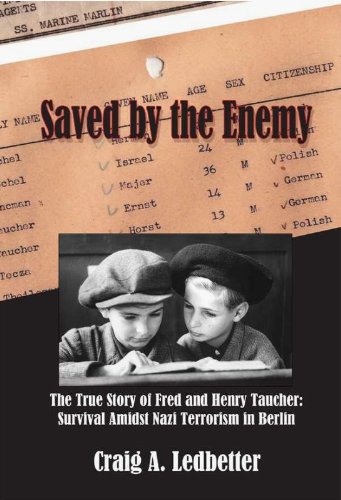
Summer Reading Response: Saved by the Enemy by Craig A. Ledbetter


This summer, one of the books I read was Saved by the Enemy by Craig A. Ledbetter. This book is mainly about how two brothers survive the holocaust. The only reason they did survive however, is because they had help from the enemy- thus the title Saved by the Enemy.While at the same time presenting both Hank and Fred Taucher's story, the book also mentions what is happening in Germany at the time.

In the beginning of the book, it starts with the two boys being born, Hank and Fred Taucher, and how Fred, the younger brother was born before the day Hitler became chancellor of Germany. Because at that time, antisemitism was strongly rising, and Fred was born with help of the enemy: a Nazi. 

I thought personally this was just luck or kindness, considering Fred's birth was in the early 1930s and World War II would not start until about six more years. However, I was wrong and throughout the thirties and mid-1940s, the Taucher family had extremely good luck, at least compared to some living in Berlin, Germany at that time. 

Overall, I think Saved by The Enemy was a really good book because It was not just a memoir or biography sort of book, it had a sort of non-fiction factual thing going on. I recommend this book.